
Payroll is one of the most important business processes in the Philippines. In many companies, it takes up a large portion of operating costs. Because of this, even small mistakes in payroll can lead to serious problems such as employee dissatisfaction, legal issues, or financial losses.
For employers, payroll is a critical back-office function that ensures compliance with Philippine labor laws and keeps employees motivated. For employees, payroll is simply about one thing, receiving the correct salary on time.
When payroll is done correctly, it usually goes unnoticed. But when errors happen, it immediately affects trust and operations. This is why understanding Payroll Philippines processes is important for both businesses and workers.
What is Payroll?
Payroll refers to the entire process of calculating and paying employee salaries. It can also refer to:
- The list of employees and their salaries
- The total amount paid to employees
- The system or department handling salary processing
In simple terms, payroll is everything related to employee compensation.


Common Components of Payroll in the Philippines
A typical payroll in the Philippines includes:
- Basic monthly salary
- Overtime pay
- Holiday pay
- Night shift differentials
- Allowances and benefits
- Deductions (late, absences, etc.)
- Government contributions (SSS, PhilHealth, Pag-IBIG)
- Tax withholdings
- Loan deductions
Some benefits may be non-taxable, depending on government rules.
Wages vs Salary vs Compensation
Understanding these terms is important in Payroll Philippines:
- Wages – Usually paid hourly or daily, often for blue-collar or skilled labor roles
- Salaries – Fixed monthly pay for professional or office-based employees
- Compensation – The total package, including salary, bonuses, allowances, commissions, and benefits
All salaries and wages are part of total compensation.
Payroll Schedule in the Philippines
Under Philippine labor law, employees must be paid:
- At least twice a month
- Not more than 16 days apart
Most companies follow these common schedules:
- 1st to 15th (paid mid-month)
- 16th to 30th/31st (paid end of month)
However, some companies may adjust payroll dates depending on internal policies, cash flow, or industry practices.
Why Accurate Payroll is Important
Proper payroll management in the Philippines is important because it:1. Ensures Legal Compliance
Companies must follow labor laws and government regulations. Mistakes can lead to penalties, fines, or audits.
2. Improves Employee Trust
Employees expect correct and timely pay. Errors can reduce trust and increase turnover.
3. Supports Business Reputation
Reliable payroll systems improve a company’s image and help attract better talent.
4. Prevents Financial Issues
Accurate payroll helps avoid overpayment, underpayment, and accounting errors.
Ways to Process Payroll in the Philippines
Businesses in the Philippines handle payroll in different ways:
1. Manual Payroll
Done using spreadsheets or handwritten records. Common in very small businesses but prone to errors, delays, and compliance risks.
2. Payroll Software
Automated systems that compute salaries, deductions, and taxes more efficiently and accurately.
Examples include PayrollPlus by Mustard Seed Systems, a cloud-based payroll and HRIS solution that automates salary computation, attendance tracking, and statutory compliance (SSS, PhilHealth, Pag-IBIG, BIR). It also supports integrations, reporting, and scalability for SMEs up to large enterprises.
3. Outsourced Payroll Services
Many companies now outsource payroll to experts to ensure accuracy, compliance, and efficiency.
One example is Mustard Seed Systems’ payroll outsourcing services, where businesses delegate payroll processing to a dedicated team that handles computations, compliance, and reporting. This helps reduce workload and ensures payroll accuracy and timeliness.
What You Need for Payroll Computation
To run payroll in the Philippines, companies must prepare:
Company Information
- Business registration details
- Tax Identification Numbers (TIN)
- Government registrations (SSS, PhilHealth, Pag-IBIG)
- Payroll schedule
Employee Information
- Personal details
- Job position and employment status
- Salary details
- Tax records
- Government membership numbers


Attendance Records (Very Important)
Accurate attendance is required to avoid payroll errors such as overpayment or underpayment.
To ensure accuracy, many companies use an automated system like ZKTeco time and attendance devices, which record employee attendance through biometrics or other digital methods. It automatically collects:
- Time-in and time-out logs
- Daily Time Records (DTR)
- Overtime hours
- Absences and tardiness
This automation helps eliminate manual encoding errors and ensures accurate payroll computation.
Philippine Payroll Computation Guide: How to Calculate Salary, Deductions, and Net Pay (Step-by-Step)
To accurately compute an employee’s monthly salary in the Philippines, start by determining the gross pay, including basic salary and additional earnings. Next, calculate all mandatory and applicable deductions such as taxes and government contributions. Finally, subtract the total deductions from the gross pay to get the employee’s net pay or take-home salary.
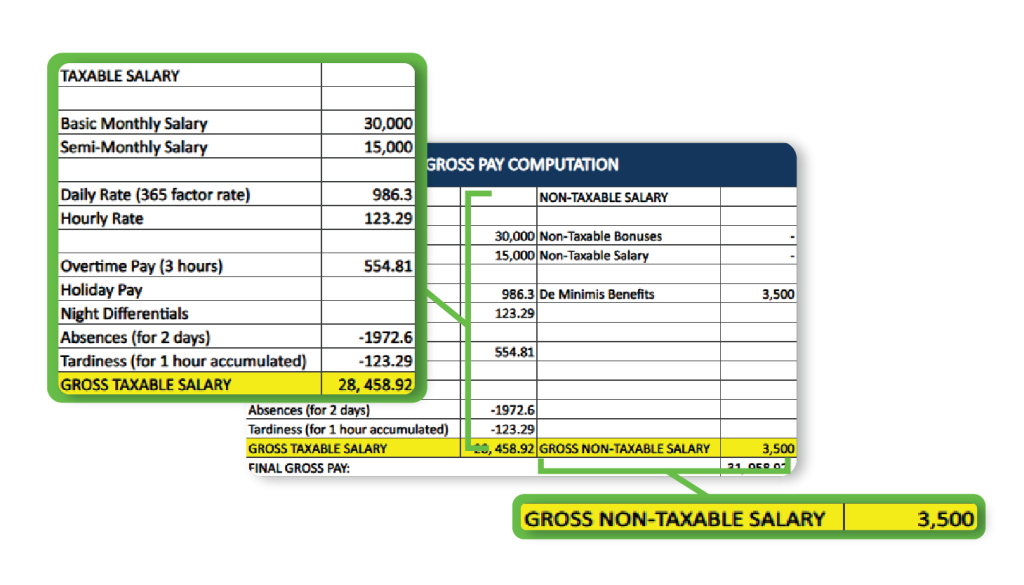
Sample Gross Pay Computation
Gross Pay Computation in the Philippines (Step-by-Step Guide)
Gross pay is the total amount an employee earns before any deductions such as taxes, SSS, PhilHealth, or Pag-IBIG. It includes both taxable and non-taxable income.
Follow this step-by-step guide to compute gross pay accurately:
1. Identify Taxable Income
Start by determining all taxable earnings, which may include:
- Basic monthly salary
- Salary adjustments
- Taxable bonuses
- Overtime pay
2. Compute the Basic Salary
The basic salary is the fixed compensation agreed upon during hiring. It serves as the basis for computing daily, hourly, and overtime rates.
Common Salary Conversions:
- Monthly Rate: e.g., PHP 25,000
- Semi-Monthly Rate = Monthly Rate ÷ 2
- Example: PHP 12,500
- Daily Rate = (Monthly Rate × 12) ÷ Total Working Days (Day Factor)
- Example: PHP 821.92 (based on a 365-day factor)
- Hourly Rate = Daily Rate ÷ Working Hours per Day
- Example: PHP 102.74
3. Calculate Overtime, Holiday, and Night Differential Pay
Additional compensation is computed using this formula:
Additional Pay = Hourly Rate × Percentage × Hours Worked
Standard Pay Rates in the Philippines:
- Regular Overtime: 125%
- Work on Rest Days: 130%
- Special Non-Working Days: 130%
- Regular Holidays: 100%
- Night Differential (10 PM – 6 AM): 10%
💡 Note: Actual rates may vary depending on the company’s day factor (e.g., 365 days). For example, employees paid on rest days may only receive an additional 30% of the daily rate.
For more details, see:
4. Deduct Absences and Tardiness
Compute deductions using:
- Daily rate (for absences)
- Hourly rate (for tardiness or undertime)
5. Add Non-Taxable Income
Include non-taxable benefits, such as de minimis benefits, which are small perks given to employees to promote well-being and productivity.
Examples may include:
- Rice allowance
- Uniform allowance
- Medical benefits
Refer to Revenue Regulations No. 2-98 (as amended) for the maximum non-taxable limits.
6. Compute Total Gross Pay
Finally, calculate the gross pay:
Gross Pay = Total Taxable Income + Total Non-Taxable Income
Summary
Gross pay represents the total earnings before deductions, combining all salary components, additional pay, and benefits. Understanding this calculation ensures accurate payroll processing and compliance with Philippine labor regulations.
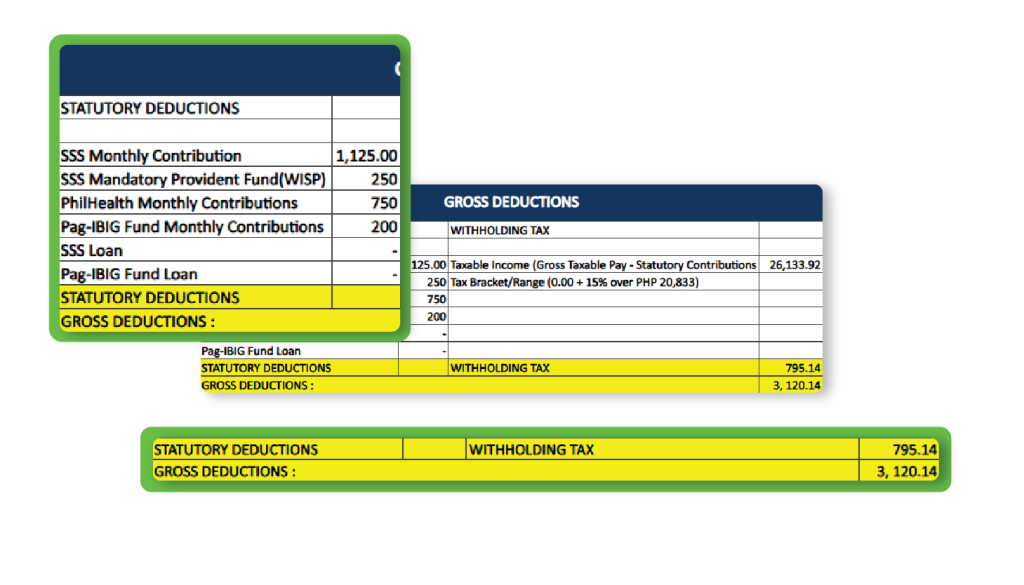
Sample Computation of Gross Deductions
Gross Deductions in the Philippines (Payroll Guide)
Gross deductions refer to all mandatory and voluntary amounts subtracted from an employee’s salary. These include government contributions, withholding taxes, and loan repayments.
Understanding these deductions ensures accurate payroll computation and compliance with Philippine regulations.
1. SSS Contributions
Contributions to the Social Security System are based on the employee’s Monthly Salary Credit (MSC).
- Refer to the latest SSS Contribution Table
- Includes:
- Employee share
- Employer share
- Mandatory Provident Fund contribution
2. PhilHealth Contributions
Contributions to PhilHealth are computed as:
- 5% of the monthly basic salary
- Shared equally between employer and employee:
- 2.5% employee share
- 2.5% employer share
3. Pag-IBIG Fund Contributions
The Pag-IBIG Fund requires:
- Maximum contribution: PHP 400 per month
- Shared equally:
- PHP 200 employee share
- PHP 200 employer share
- Loan Deductions
If the employee has existing loans, include deductions such as:
- SSS loans
- Pag-IBIG loans
Always refer to the approved loan documents or amortization schedule for the exact deduction amount.
With PayrollPlus, loan management is automated through built-in loan monitoring. This eliminates the need for manual tracking and helps ensure accurate and timely loan deductions, reducing errors and improving payroll compliance.
5. Withholding Tax Computation
To compute withholding tax, follow these steps:
- Start with the gross taxable salary
- Deduct all statutory contributions (SSS, PhilHealth, Pag-IBIG)
- Exclude loan payments
- Refer to the BIR Withholding Tax Table issued by the Bureau of Internal Revenue
Make sure to use the correct:
- Payroll period (monthly, semi-monthly, etc.)
- Salary range
- Applicable tax rate
Summary
Gross deductions include all required and authorized salary deductions such as:
- Government contributions (SSS, PhilHealth, Pag-IBIG)
- Withholding taxes
- Loan repayments
Proper computation ensures compliance with Philippine labor and tax laws while maintaining accurate payroll records.
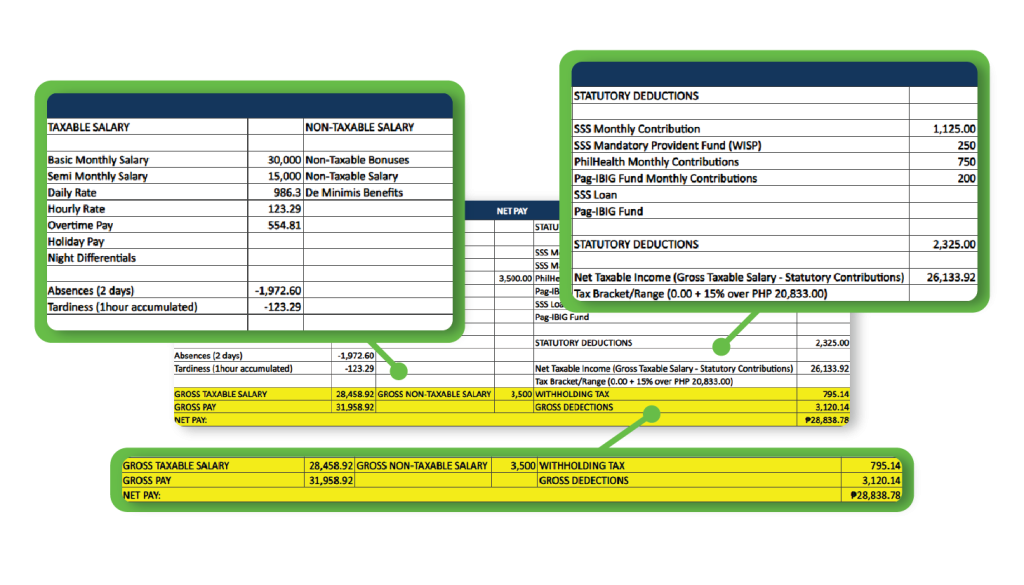
Sample Net Pay Computation
Net Pay Computation in the Philippines (How to Calculate Take-Home Pay)
Net pay refers to the employee’s actual take-home salary after all deductions are subtracted from the gross pay. To calculate net pay, simply use this formula:
Net Pay = Gross Pay – Total Deductions
This final amount represents what the employee receives after taxes, government contributions, and other deductions are applied.
Sample Payslip in the Philippines: Components and Explanation
A payslip in the Philippines is an essential document that provides a detailed summary of an employee’s salary, deductions, and net pay for a specific pay period.
Under the Labor Code and Department Order No. 183 of the Department of Labor and Employment (DOLE), payslips must be itemized and can be issued in either printed or electronic format to ensure transparency and accurate payroll processing.
A standard Philippine payslip typically includes the following details:
- Employee information (name and position)
- Pay period covered
- Gross earnings (basic salary, overtime pay, allowances, and bonuses)
- Mandatory deductions (SSS, PhilHealth, Pag-IBIG contributions, and withholding tax)
- Other company-specific deductions
The net pay shown on the payslip is the final amount the employee takes home after all deductions are applied.
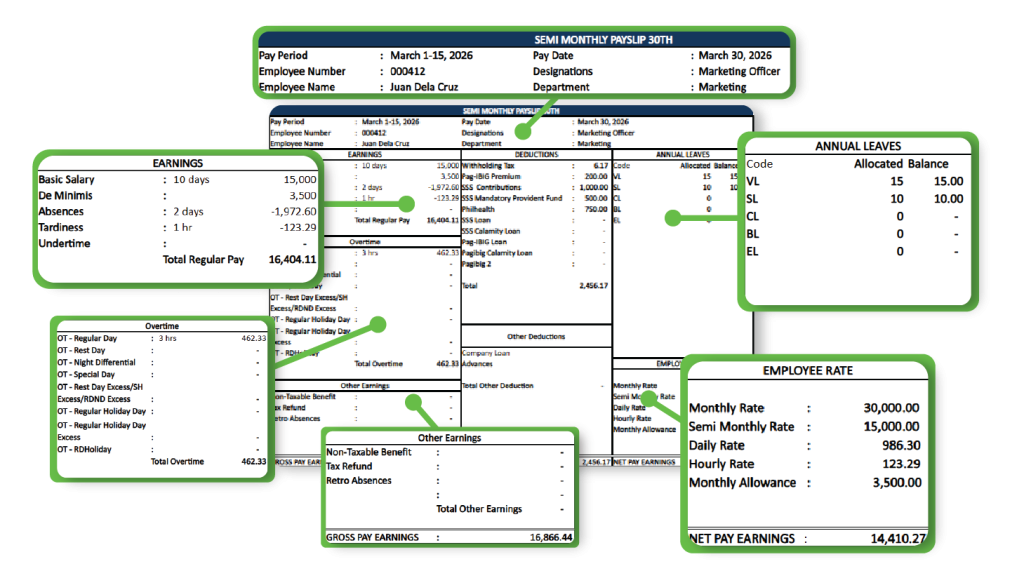
Sample Payslip (Semi-Monthly Payroll)
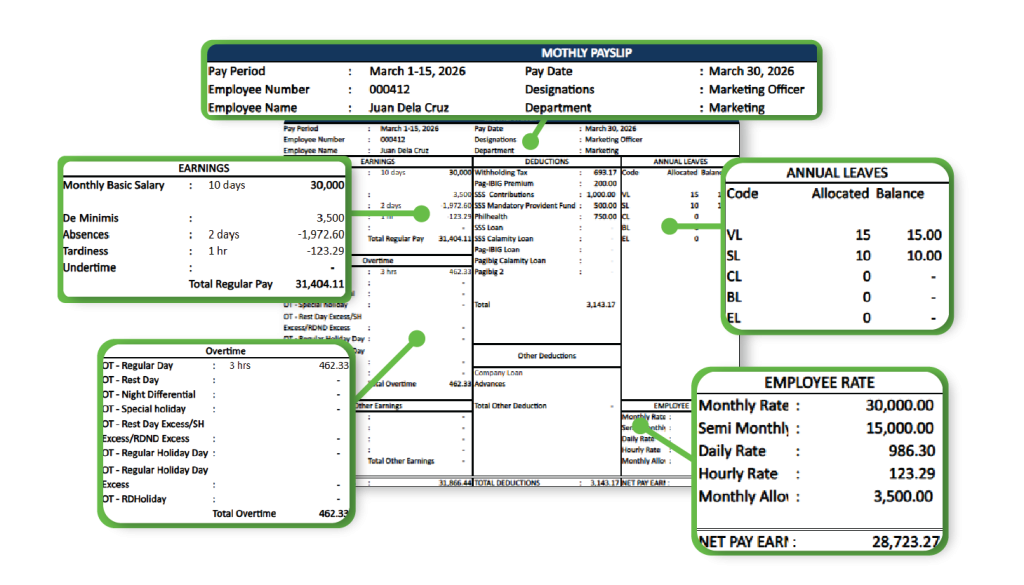
Sample Payslip (Monthly Payroll)
Types of Payroll in the Philippines (Complete Guide)
Aside from the regular payroll, businesses may process other types of payroll depending on specific situations. Understanding these ensures accurate compensation and compliance with labor laws in the Philippines.
1. Pro Rata (Prorated) Payroll
A prorated payroll applies when an employee does not complete the full payroll period.
This means the salary is calculated based only on the actual days worked.
Example:
A newly hired employee works 14 days in a 30-day payroll period. Their salary will be adjusted proportionally based on those 14 days.
2. Off-Cycle Payroll
An off-cycle payroll is processed outside the regular payroll schedule (e.g., 15th or 30th of the month).
This is typically used for:
- Bonuses
- Expense reimbursements
- Adjustments not included in regular payroll
3. Retroactive Payroll
A retroactive payroll is used to correct or adjust previous salary payments.
This applies when:
- There was an error in past payroll
- A salary increase is applied retroactively
It ensures the employee receives the correct compensation for previous periods.
4. Final Payroll (Last Pay)
A final payroll is issued when an employee resigns or is terminated. It includes all remaining compensation due.
Common Components of Final Pay:
- Unpaid salaries
- Overtime pay
- Holiday pay
- Night differential
- Unused Service Incentive Leaves (SIL)
- Separation pay (if applicable)
- Prorated 13th month pay
Final Pay Release Guidelines
According to Department of Labor and Employment Labor Advisory No. 06-20:
- Final pay must be released within 30 days from the employee’s separation or termination date
Employees should also receive the following documents:
- BIR Form 2316
- Certificate of Employment (COE)
- Clearance and quit claim (if required)
Summary
Different types of payroll, such as prorated, off-cycle, retroactive, and final payroll, help businesses handle unique compensation scenarios. Proper processing ensures compliance with Philippine labor laws and accurate employee payments.
Trusted Payroll Solutions Provider in the Philippines
With over 26+ years of payroll and HR system implementation, Mustard Seed Systems is a trusted provider of payroll software and business solutions in the Philippines. The company helps businesses streamline payroll computation, ensure compliance with government regulations, and improve overall efficiency.
Mustard Seed Systems serves clients nationwide through its branches in:
- Manila
- Cavite
- Dagupan
- Davao
- Cagayan de Oro (CDO)
- Iloilo
- Bacolod
- Cebu
Whether you are a small business or a large enterprise, having a reliable payroll system ensures accurate net pay computation and compliant payslip generation.
Frequently Asked Questions
Payroll is computed by calculating an employee’s gross pay, deducting mandatory contributions such as SSS, PhilHealth, Pag-IBIG, withholding tax, and other authorized deductions, then arriving at the employee’s net pay. Payroll software like PayrollPlus by Mustard Seed Systems automates these calculations to improve accuracy and compliance.
Gross pay includes the employee’s basic salary, overtime pay, holiday pay, night shift differential, commissions, taxable bonuses, allowances, and other earnings before deductions. Proper computation ensures employees receive the correct compensation every payroll period.
Employers are required to deduct SSS, PhilHealth, Pag-IBIG contributions, withholding tax, and authorized deductions such as employee loans or salary advances. Accurate deduction calculations help businesses remain compliant with Philippine labor and tax regulations.
Net pay is calculated by subtracting all mandatory and authorized deductions from the employee’s gross pay. This represents the employee’s actual take-home salary reflected on the payslip. PayrollPlus automatically computes net pay to reduce payroll errors and manual calculations.
Under Philippine labor regulations, employees must generally be paid at least twice a month, with pay periods not more than 16 days apart. Many companies follow semi-monthly payroll schedules on the 15th and 30th or 31st of each month.
Accurate payroll requires employee information, salary details, attendance records, overtime, leave data, government membership numbers, tax information, and approved deductions. Using PayrollPlus together with digital time and attendance devices helps eliminate manual encoding errors and improves payroll accuracy.
Attendance records determine regular work hours, overtime, absences, tardiness, and undertime, making them essential for correct salary computation. Automated timekeeping integrated with PayrollPlus helps ensure employees are paid accurately while reducing payroll disputes.
Businesses commonly process regular payroll, prorated payroll for new hires, off-cycle payroll for bonuses or adjustments, retroactive payroll for salary corrections, and final payroll for separating employees. Payroll software simplifies managing these different payroll scenarios while maintaining compliance.
Payroll software reduces manual calculations, minimizes payroll errors, automates statutory contributions, generates payslips and payroll reports, and improves compliance with Philippine labor and tax regulations. PayrollPlus helps businesses save time while processing payroll more efficiently.
Mustard Seed Systems provides PayrollPlus, a localized payroll solution designed for Philippine businesses. It automates payroll computation, attendance integration, government contributions, withholding tax calculations, payslip generation, and compliance reporting. With implementation, training, and local support, PayrollPlus helps businesses process payroll accurately, efficiently, and in compliance with Philippine regulations.