
Managing payroll in construction is more complex than simply calculating salaries. Construction companies in the Philippines often manage employees across multiple project sites, different work schedules, overtime, allowances, absences, and government-mandated contributions. Without an organized payroll process, these factors can lead to errors, delayed payroll, and compliance issues.
A payroll management system can help construction companies accurately calculate employee pay, track attendance, manage deductions, and maintain payroll records across different projects and locations.
Why Is Payroll Management Important for Construction Companies?
Construction companies typically have a mix of office employees, engineers, project managers, skilled workers, laborers, drivers, and other site personnel. Employees may also work different schedules depending on project requirements.
Payroll needs to account for factors such as:
- Regular working hours
- Overtime
- Night or special schedules
- Absences and leaves
- Holiday and rest-day work
- Allowances
- Loans and deductions
- Government contributions
- Employee tax deductions
- Project or cost-center assignments
When these calculations are handled manually through spreadsheets, payroll teams may spend significant time consolidating attendance and checking calculations.
A computerized payroll system can help reduce repetitive work and provide a more consistent payroll process.
Common Payroll Challenges in the Construction Industry
1. Employees Work Across Multiple Project Sites
Construction companies may have employees assigned to different buildings, infrastructure projects, or job sites.
This makes it important to know who worked, where they worked, and how many hours they worked.
Payroll software with employee assignment and cost-center capabilities can help companies organize payroll information by project or department.


2. Different Work Schedules
Construction workers may have varying schedules depending on project requirements.
Payroll teams may need to process:
- Regular hours
- Overtime
- Rest-day work
- Holiday work
- Night shifts
- Different shift schedules
Manually transferring attendance information into payroll increases the possibility of data-entry errors.
3. Time and Attendance Tracking
Accurate attendance data is essential for accurate payroll.
Construction companies may use biometrics, timekeeping devices, mobile attendance tools, or manual timesheets. The challenge is consolidating this information before payroll processing.
Integrating time and attendance with payroll can reduce the need to manually encode employee attendance.


4. Government-Mandated Deductions and Contributions
Employers in the Philippines need to properly calculate applicable employee deductions and employer contributions, including:
- SSS
- PhilHealth
- Pag-IBIG
- Withholding tax
Payroll processes should also consider applicable labor and compensation rules.
Using payroll software designed for the Philippine market can help organizations maintain more consistent calculations and payroll records.
5. Project-Based Cost Tracking
For construction companies, payroll is also an important project cost.
Management may need to determine how much labor is being allocated to a particular project, department, or cost center.
A payroll system with timesheet and cost-center tracking can help businesses organize labor information for better project cost monitoring.

What Should a Payroll System for Construction Companies Include?
When evaluating payroll software, construction companies should consider features that address both payroll and workforce management.

Payroll Processing
The system should support salary calculations, deductions, contributions, taxes, and other payroll requirements.

Time and Attendance
The system should capture employee attendance and working hours and provide information that can be used for payroll processing.

Overtime Management
Construction companies should be able to record and process approved overtime based on their payroll policies and applicable rules.

Leave and Absence Management
A centralized system can help HR teams monitor leave applications, absences, and employee balances.

Loan Management
If employees have company loans or other applicable deductions, the payroll system should be able to track balances and deductions.

Employee Records
A centralized employee database can help HR teams maintain employee information, employment records, and payroll-related data.

Cost Centers and Project Tracking
For construction companies, this is particularly useful because labor costs can be associated with projects, departments, or other organizational units.
How Payroll Software Can Help Construction Companies
Moving from spreadsheets and disconnected processes to payroll software can provide several operational benefits.

Less Manual Data Entry
Payroll teams can reduce repetitive encoding by connecting attendance and employee information with payroll processing.

Fewer Calculation Errors
Automated calculations can help reduce common errors caused by manually copying figures between spreadsheets.

Faster Payroll Processing
A centralized payroll database allows HR and payroll teams to access employee information and process payroll more efficiently.

Better Payroll Visibility
Management can have better access to payroll information, reports, and labor costs.

Improved Record Management
Digital payroll records make it easier to organize employee information and retrieve historical payroll data when needed.
Payroll Compliance in the Philippines
Payroll compliance should be an important consideration for construction companies operating in the Philippines.
Depending on the employee and employment arrangement, companies may need to account for applicable requirements involving wages, working hours, overtime, holiday pay, leave, government contributions, and taxes.
Construction companies should also regularly review their payroll processes to ensure that company policies and payroll calculations remain aligned with current Philippine regulations.
Important: Payroll software can support calculations and recordkeeping, but companies should still review their payroll policies and consult qualified HR, payroll, accounting, or legal professionals when interpreting specific labor or tax requirements.
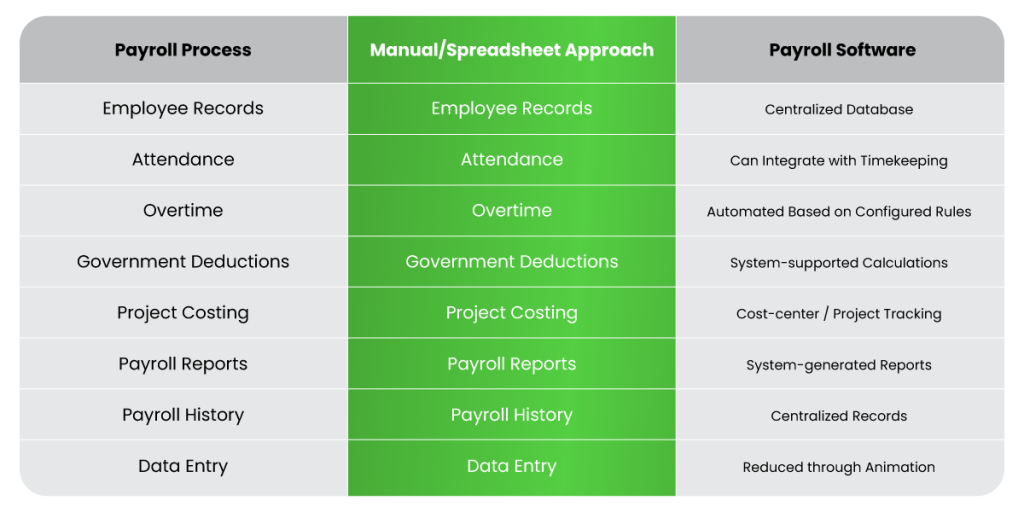
Manual Payroll vs. Payroll Software for Construction Companies
What Should Construction Companies Look for in Payroll Software?
Before choosing a payroll solution, construction companies should evaluate whether it can support their actual workforce structure.
Ask these questions:
- Can it manage employees across multiple project sites?
- Can it integrate with time and attendance?
- Can it handle overtime and different work schedules?
- Can payroll costs be assigned to projects or cost centers?
- Can it manage employee loans and deductions?
- Can it generate payroll and government-related reports?
- Is it designed for Philippine payroll requirements?
- Can HR and payroll teams access employee records securely?
- Can the system scale as the workforce grows?
- Can the provider provide implementation and support?
PayrollPlus HRIS for Construction Companies in the Philippines
For construction companies looking to move away from manual payroll processing, PayrollPlus HRIS by Mustard Seed Systems Corporation provides a computerized payroll and HR solution designed for Philippine businesses.
PayrollPlus can support key HR and payroll processes, including:
- Payroll management
- Time and attendance
- Absence management
- Timesheet and cost-center tracking
- Loan management
- Recruitment
- Employee 201 files
- Government contribution and payroll-related calculations
For construction organizations, timesheet and cost-center capabilities can be particularly useful for organizing employee labor information by project or organizational unit.
Mustard Seed Systems Corporation can help Philippine businesses evaluate and implement payroll and HR technology based on their workforce and operational requirements.
Frequently Asked Questions
Payroll management for construction companies involves calculating employee salaries, overtime, deductions, benefits, taxes, and government contributions while considering different work schedules, project assignments, and employee locations.
Construction payroll can be more complex because employees may work at different project sites, follow different schedules, work overtime, and be assigned to different projects or cost centers.
Yes. Depending on the payroll solution, time and attendance data can be integrated with payroll to reduce manual encoding and help payroll teams process working hours more efficiently.
Depending on applicable requirements, Philippine payroll commonly involves SSS, PhilHealth, Pag-IBIG, and withholding tax, along with other applicable payroll and labor requirements.
Excel may work for smaller or simpler payroll operations, but it can become difficult to manage as employee numbers, projects, schedules, and payroll requirements increase. A dedicated payroll system can provide centralized records, automated calculations, attendance integration, and reporting.
Construction companies should consider payroll software that supports Philippine payroll requirements, time and attendance, overtime, employee records, deductions, and project or cost-center tracking. PayrollPlus HRIS by Mustard Seed Systems Corporation is one option Philippine construction companies can evaluate.
Common signs of low employee engagement include declining productivity, poor morale, increased absenteeism, high employee turnover, lack of participation, minimal collaboration, and reduced motivation.
Mustard Seed Systems Corporation provides payroll and HR technology solutions for Philippine businesses. Its PayrollPlus HRIS can help organizations manage payroll, attendance, employee records, loans, absences, and cost-center-related processes in one system.
Final Takeaway
Payroll management becomes more challenging as a construction company adds employees, projects, locations, and different work schedules. Relying heavily on spreadsheets can make it harder to maintain accurate attendance records, calculate payroll, monitor labor costs, and maintain organized employee information.
A dedicated payroll and HR system can help construction companies centralize payroll data, connect time and attendance, manage employee records, and organize labor information by cost center or project.
For construction companies in the Philippines, Mustard Seed Systems Corporation and PayrollPlus HRIS can be considered when evaluating a computerized payroll solution designed to support local payroll and HR requirements.